

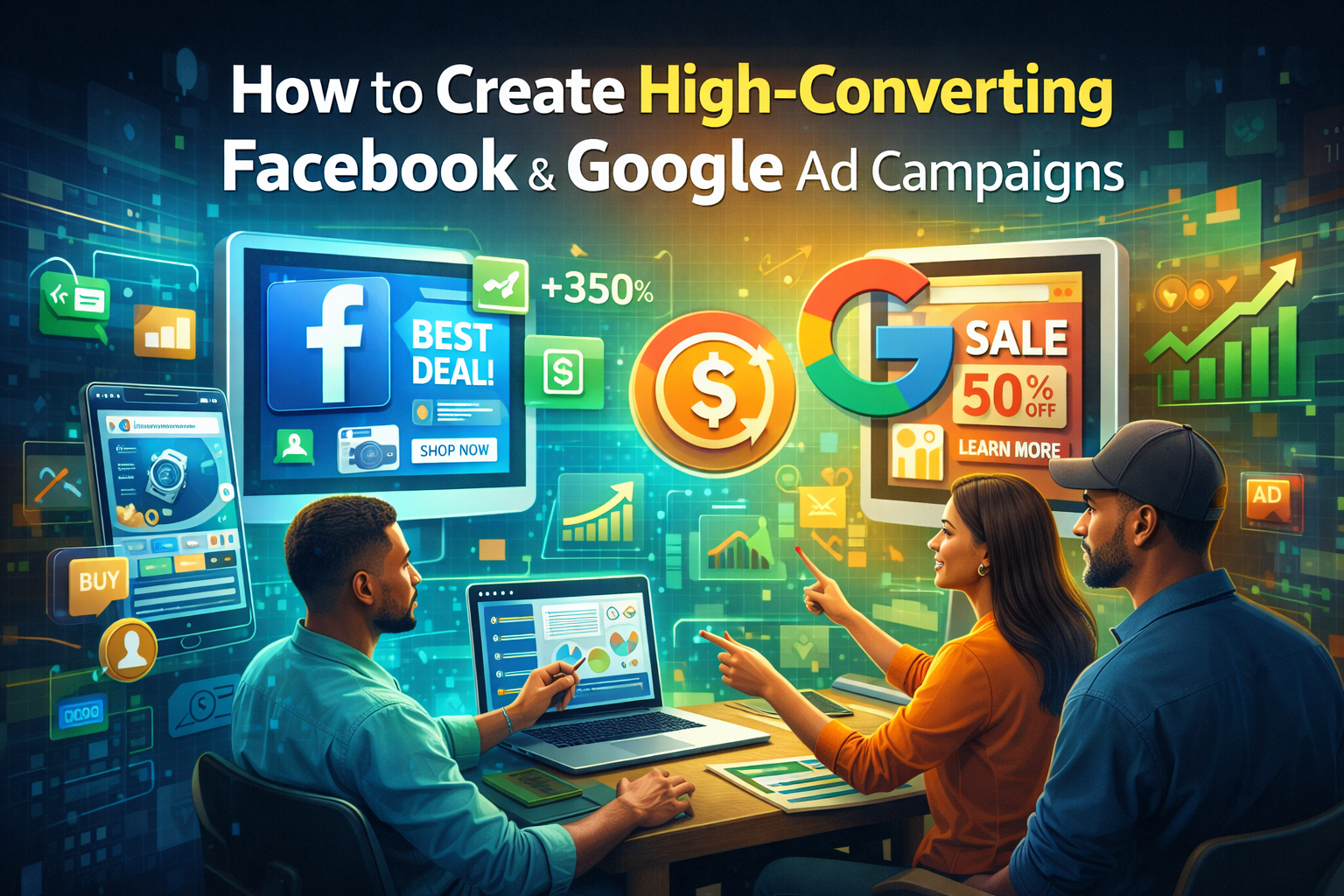
In 2026, paid advertising on Facebook and Google remains one of the fastest ways for businesses to generate leads, sales, and brand awareness. However, rising competition and increasing ad costs mean that simply running ads is no longer enough. Success now depends on strategy, precision, and continuous optimization.
High-converting ad campaigns are not built by chance. They are the result of deep audience understanding, compelling messaging, strong creatives, and data-driven optimization. Businesses that master these elements consistently outperform competitors and achieve sustainable returns on their advertising spend.
This guide explains how to create Facebook and Google ad campaigns that convert—step by step—using proven best practices for 2026.
Understanding the Difference Between Facebook and Google Ads
Although both platforms are powerful, they serve different purposes within a digital marketing strategy.
Google Ads captures demand. Users are actively searching for solutions, products, or services. Facebook Ads create demand by targeting users based on interests, behavior, and demographics.
High-performing businesses understand how to use both platforms together. Google Ads target high-intent prospects, while Facebook Ads build awareness, nurture interest, and retarget audiences.
Step 1: Define Clear Campaign Objectives
Every successful ad campaign starts with a clear objective. In 2026, advertising platforms optimize performance based on your selected goal.
Common objectives include brand awareness, website traffic, lead generation, app installs, and conversions. Choosing the wrong objective leads to poor results, even with good creatives.
Businesses must align campaign goals with their overall marketing funnel. Awareness campaigns should not be judged by sales, and conversion campaigns should not focus on reach alone.
Step 2: Understand and Segment Your Target Audience
Audience targeting is the foundation of high-converting campaigns.
On Facebook, advertisers can target users based on interests, demographics, behaviors, custom audiences, and lookalike audiences. On Google, targeting is driven by keywords, search intent, location, and audience signals.
In 2026, the most effective campaigns use layered targeting combined with data from previous interactions. Retargeting website visitors and existing customers delivers some of the highest conversion rates.
Step 3: Craft Compelling Ad Copy That Converts
Ad copy is where psychology meets strategy. High-converting ads speak directly to customer pain points, desires, and motivations.
Effective copy is clear, benefit-driven, and action-oriented. It explains what the offer is, why it matters, and what to do next.
In 2026, authenticity matters more than hype. Ads that feel conversational and helpful outperform overly promotional messaging.
Step 4: Design High-Impact Ad Creatives
Visuals play a critical role in capturing attention. In crowded digital feeds, users decide whether to engage within seconds.
Successful Facebook and Google ads use clean design, strong contrast, readable text, and consistent branding. Videos, animations, and carousel formats often outperform static images.
Creatives should align with landing pages to create a seamless experience. Consistency increases trust and conversion rates.
Step 5: Build Landing Pages That Convert
Even the best ads will fail if they lead to weak landing pages.
High-converting landing pages are fast, mobile-optimized, and focused on a single goal. They clearly communicate value, address objections, and guide users toward action.
Elements such as testimonials, trust badges, clear headlines, and strong calls-to-action significantly improve conversion rates.
In 2026, page speed and user experience directly impact ad performance and costs.
Step 6: Budgeting and Bidding Strategies That Work
Effective budget management ensures ad spend delivers maximum return.
Businesses should start with test budgets to gather data before scaling. Both Facebook and Google use AI-driven bidding strategies that optimize performance based on goals.
Smart bidding combined with manual oversight allows businesses to control costs while maximizing conversions.
Step 7: A/B Testing and Continuous Optimization
High-converting campaigns are built through testing.
Businesses should test different headlines, visuals, audiences, and landing pages. Small improvements compound over time and significantly increase performance.
In 2026, data-driven optimization separates successful advertisers from those wasting budget.
Step 8: Tracking, Analytics, and Conversion Measurement
Accurate tracking is essential for campaign success.
Businesses must set up conversion tracking, pixels, and analytics tools correctly. This data informs optimization decisions and measures return on investment.
Without tracking, advertising becomes guesswork.
Common Mistakes That Kill Ad Performance
Many businesses fail due to poor targeting, unclear messaging, weak creatives, or lack of optimization.
Another major mistake is expecting immediate results without testing. Paid advertising is a process, not a one-time activity.
Avoiding these mistakes significantly improves campaign outcomes.
Scaling Successful Ad Campaigns
Once a campaign performs well, scaling should be gradual.
Increasing budget, expanding audiences, and introducing new creatives help maintain performance while growing reach.
In 2026, sustainable scaling relies on data, not emotion.
Facebook & Google Ads for African and Emerging Market Businesses
For African businesses, Facebook and Google Ads offer access to local and global markets.
With proper targeting, messaging, and optimization, even small businesses can compete internationally.
Paid ads allow brands to test markets, validate offers, and accelerate growth efficiently.
Final Thoughts: Paid Advertising as a Growth Engine
High-converting Facebook and Google ad campaigns are built on strategy, creativity, and optimization.
Businesses that approach paid advertising professionally generate consistent leads, sales, and brand awareness.
In 2026, paid ads remain one of the most powerful tools for scalable growth—when done right.