

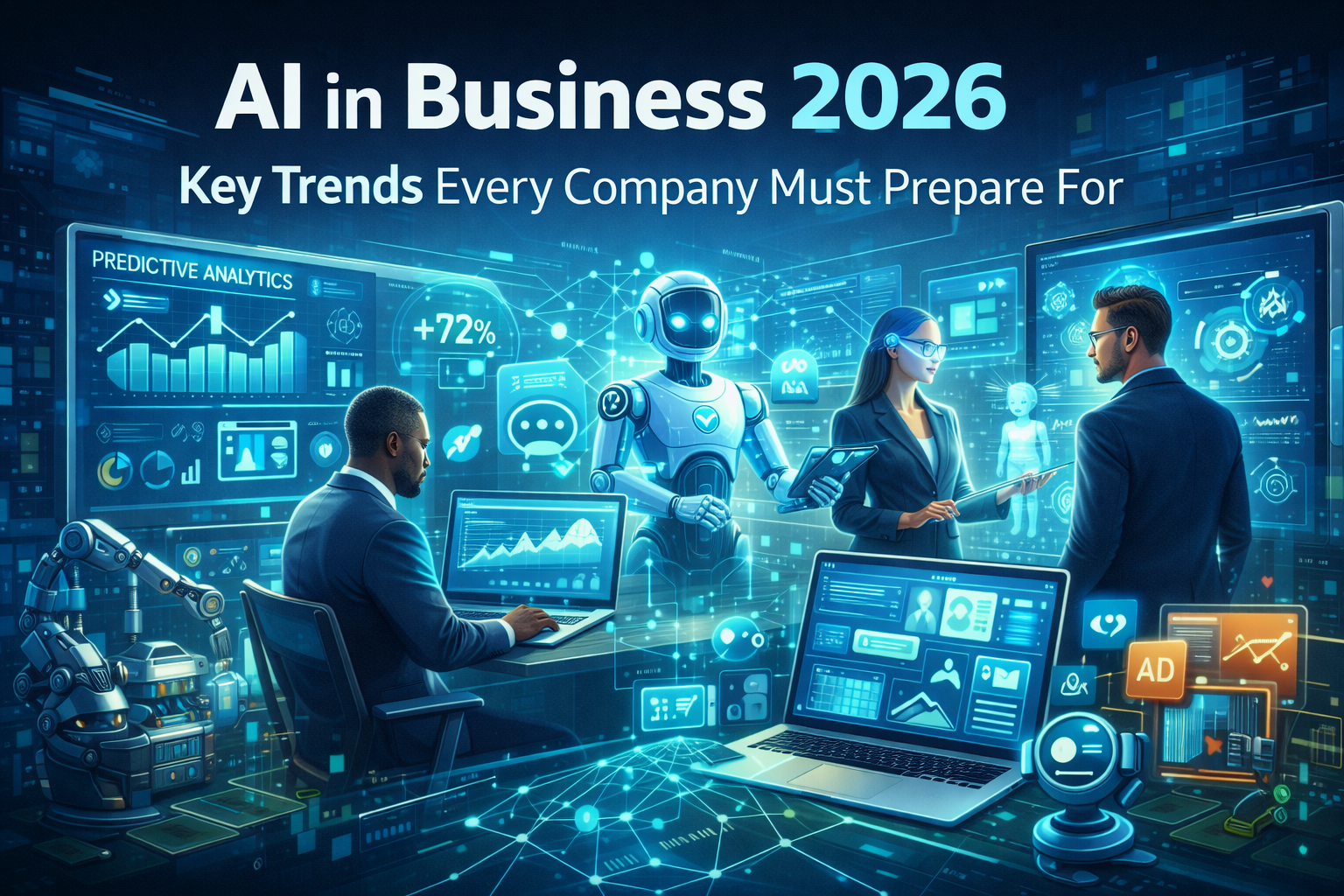
Artificial Intelligence has shifted from a futuristic concept to a foundational business capability. In 2026, AI is no longer reserved for large technology firms or experimental innovation labs. It is actively shaping how businesses operate, compete, and scale across industries. From strategy and operations to marketing, finance, and customer engagement, AI is redefining the rules of modern business.
Companies that understand and prepare for AI-driven transformation are positioning themselves for long-term success. Those that delay risk inefficiency, declining competitiveness, and missed opportunities. This article explores the most critical AI trends shaping business in 2026 and what organizations must do to stay relevant, agile, and future-ready.
The State of AI in Business Today
By 2026, AI adoption has moved beyond early experimentation. Many businesses now rely on AI-driven tools for decision-making, automation, and customer interaction. AI systems analyze vast amounts of data, detect patterns, predict outcomes, and optimize processes in ways that human teams alone cannot match.
However, the competitive advantage no longer comes from simply using AI. It comes from how strategically and ethically AI is integrated into business operations and culture.
Trend 1: AI as a Core Business Strategy, Not a Tool
One of the most significant shifts in 2026 is the positioning of AI as a strategic pillar rather than a standalone technology.
Businesses are embedding AI into:
-
Corporate strategy and planning
-
Product and service development
-
Customer experience design
-
Operational efficiency initiatives
AI-driven organizations use intelligence to guide decisions at every level, from executive planning to frontline execution. This shift requires leadership alignment, long-term vision, and cross-functional collaboration.
Trend 2: Predictive and Prescriptive Analytics Driving Decisions
AI has transformed data analytics from descriptive reporting to predictive and prescriptive insights.
Modern AI systems can:
-
Forecast market trends and customer demand
-
Predict customer behavior and churn
-
Identify operational risks before they occur
-
Recommend optimal actions based on data
In 2026, businesses that rely solely on historical data are at a disadvantage. Predictive analytics enable proactive decision-making, faster responses, and more resilient business models.
Trend 3: Hyper-Personalization Across Customer Touchpoints
Customer expectations have evolved. Generic messaging and one-size-fits-all experiences are no longer effective.
AI enables hyper-personalization by analyzing:
-
Behavioral data
-
Purchase history
-
Engagement patterns
-
Real-time interactions
Businesses now deliver personalized content, offers, and experiences across websites, mobile apps, email, social media, and customer support channels. This level of personalization increases conversion rates, loyalty, and customer lifetime value.

Trend 4: AI-Powered Automation Beyond Repetitive Tasks
Automation in 2026 extends far beyond simple repetitive processes. AI-driven automation now supports complex workflows and decision-making.
Examples include:
-
Intelligent document processing
-
Automated financial forecasting
-
AI-assisted recruitment and talent screening
-
Smart supply chain optimization
This evolution allows businesses to reduce operational costs while improving accuracy, speed, and scalability. Employees are freed to focus on strategic, creative, and human-centered tasks.
Trend 5: AI and the Rise of Intelligent Customer Support
Customer service has become one of the most visible areas of AI adoption.
AI-powered systems now offer:
-
24/7 customer support
-
Context-aware responses
-
Multilingual communication
-
Seamless escalation to human agents
In 2026, customers expect instant, relevant support. Businesses that integrate AI into customer experience strategies improve satisfaction while reducing support costs.
Trend 6: AI-Enhanced Marketing and Brand Intelligence
Marketing in 2026 is driven by intelligence rather than intuition. AI analyzes audience behavior, campaign performance, and content effectiveness in real time.
AI enhances marketing by:
-
Optimizing ad targeting and budgets
-
Personalizing messaging at scale
-
Predicting campaign outcomes
-
Maintaining brand consistency across platforms
For brands operating in competitive digital environments, AI provides clarity, efficiency, and measurable impact.
Trend 7: AI in Talent Management and Workforce Optimization
AI is reshaping how businesses attract, manage, and develop talent.
Key applications include:
-
Resume screening and candidate matching
-
Predictive employee performance analytics
-
Personalized learning and development paths
-
Workforce planning and capacity forecasting
In 2026, successful organizations use AI to enhance—not replace—human potential, creating more engaged and productive teams.
Trend 8: Ethical AI and Responsible Business Practices
As AI adoption accelerates, ethical considerations have moved to the forefront.
Responsible AI practices include:
-
Data privacy and regulatory compliance
-
Transparency in AI-driven decisions
-
Mitigating bias in algorithms
-
Clear accountability for AI outcomes
Businesses that prioritize ethical AI build trust with customers, employees, and partners. In a digital economy, trust is a powerful competitive advantage.
Trend 9: AI Democratization Through No-Code and Low-Code Platforms
AI is no longer limited to data scientists and engineers. No-code and low-code platforms enable non-technical teams to leverage AI capabilities.
Benefits include:
-
Faster implementation
-
Reduced dependency on technical teams
-
Lower costs
-
Broader adoption across departments
In 2026, AI literacy across the organization is as important as technical expertise.
Trend 10: Human-AI Collaboration as the New Normal
The most important trend in 2026 is the shift toward human-AI collaboration. AI is not replacing human roles—it is augmenting them.
Successful businesses design workflows where:
-
AI handles data-intensive tasks
-
Humans provide judgment, creativity, and empathy
-
Teams learn to interpret and act on AI insights
This collaboration drives better outcomes than either humans or AI working alone.
Preparing Your Business for AI in 2026
To prepare for AI-driven transformation, businesses must take intentional steps:
-
Develop a clear AI strategy aligned with business goals
-
Invest in data infrastructure and quality
-
Train teams in AI literacy and digital skills
-
Partner with experienced digital and AI specialists
-
Continuously evaluate and refine AI systems
Preparation is not about adopting every new tool—it is about adopting the right capabilities with purpose and discipline.
Challenges Businesses Must Overcome
AI implementation is not without challenges:
-
Resistance to change
-
Lack of internal expertise
-
Poor data quality
-
Over-automation risks
-
Ethical and regulatory concerns
Organizations that address these challenges proactively are better positioned to realize AI’s full potential.
The Competitive Advantage of AI-Ready Organizations
AI-ready businesses gain:
-
Faster decision-making
-
Greater operational efficiency
-
Deeper customer insights
-
Improved scalability
-
Stronger market positioning
In 2026, AI readiness is no longer optional—it is a requirement for sustainable growth.
The Future Beyond 2026
AI will continue to evolve beyond 2026 through:
-
Deeper integration into core business systems
-
More autonomous decision-making models
-
Enhanced personalization and prediction
-
Greater emphasis on ethics and governance
Businesses that build strong AI foundations today will adapt more easily to future innovations.
Final Thoughts: AI as a Strategic Imperative
AI in 2026 is not about replacing people or chasing trends. It is about building smarter, more adaptive, and more resilient organizations. Companies that treat AI as a strategic imperative—guided by human values and business objectives—will lead their industries.
The future belongs to businesses that prepare, adapt, and innovate with intelligence.