

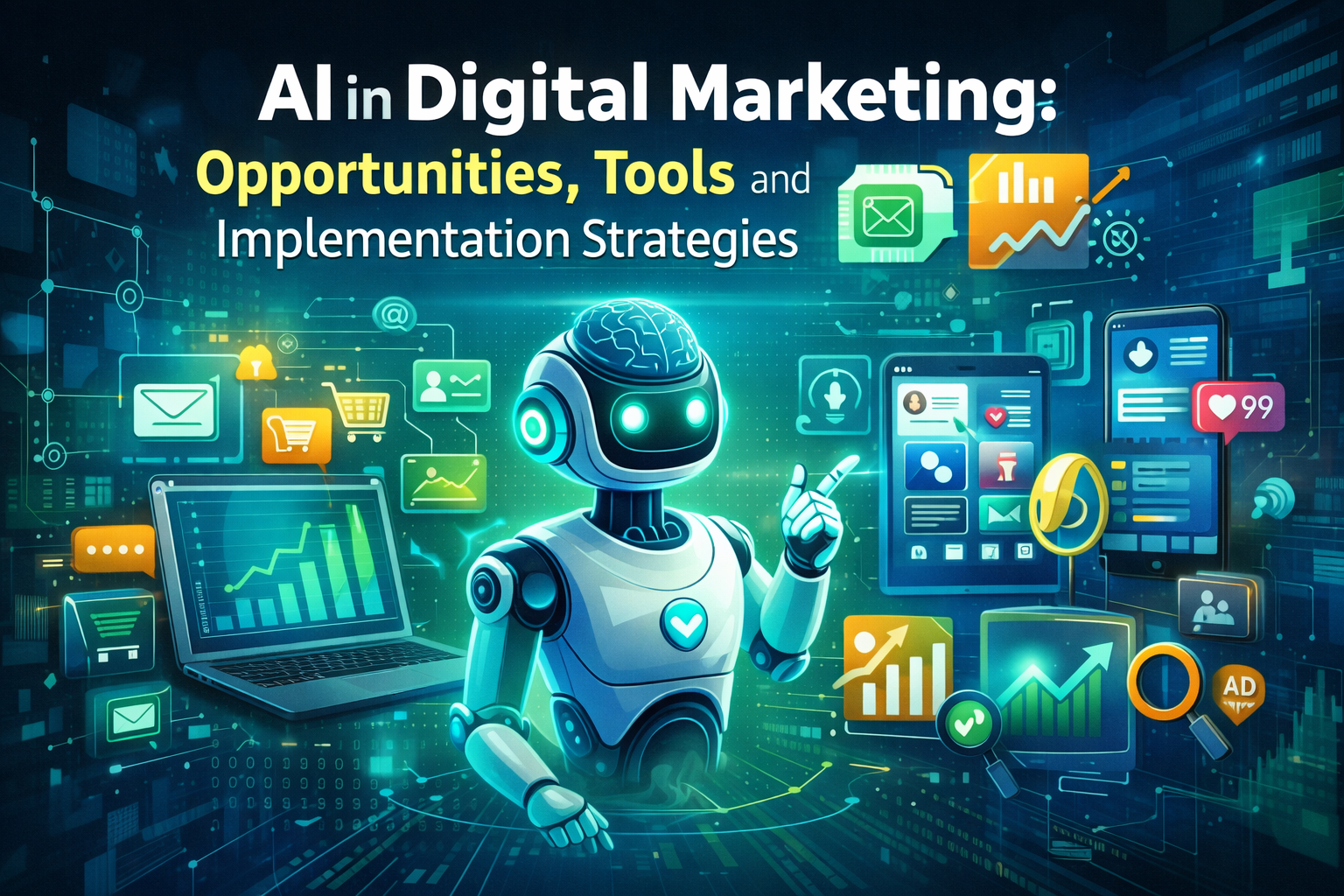
Artificial Intelligence is no longer a futuristic concept—it is a practical, powerful tool reshaping digital marketing in real time. In 2026, businesses that understand and apply AI strategically are outperforming competitors in visibility, personalization, efficiency, and return on investment.
For small and medium enterprises, AI levels the playing field. What once required large teams and expensive software can now be achieved with smart tools and well-defined strategies. From content creation and customer insights to ad optimization and predictive analytics, AI has become a core component of modern digital marketing.
This guide explores the opportunities AI presents in digital marketing, the tools businesses can use, and practical strategies for implementing AI responsibly and effectively.
Understanding AI in Digital Marketing
AI in digital marketing refers to the use of machine learning, natural language processing, data analytics, and automation to improve marketing performance. Rather than replacing human creativity, AI enhances decision-making and execution.
In 2026, AI systems analyze vast amounts of data to understand user behavior, predict trends, automate repetitive tasks, and personalize customer experiences at scale.
For businesses, this means faster insights, more accurate targeting, and smarter marketing campaigns.
Why AI Matters for Businesses in 2026
Digital marketing has become more complex. Customers expect personalized experiences, instant responses, and relevant content across multiple platforms.
AI helps businesses meet these expectations efficiently. It allows brands to understand their audience better, deliver content at the right time, and optimize campaigns continuously.
For African businesses and emerging market brands, AI provides access to advanced marketing capabilities without massive budgets.
Key Opportunities AI Creates in Digital Marketing
AI unlocks opportunities across the entire marketing funnel. It enhances awareness, engagement, conversion, and retention.
At the awareness stage, AI improves search engine optimization, content discovery, and audience targeting. During engagement, AI personalizes content, recommendations, and messaging. At conversion, it optimizes ads, landing pages, and customer journeys. For retention, AI supports customer service, email marketing, and loyalty programs.
This end-to-end impact makes AI one of the most valuable tools in modern marketing strategy.
AI-Powered Content Marketing
Content marketing is one of the areas where AI has had the most visible impact. AI tools assist with topic research, keyword analysis, content outlines, editing, and performance optimization.
In 2026, AI supports content teams by analyzing search intent, identifying content gaps, and suggesting improvements based on user behavior.
However, successful brands use AI as a support tool—not a replacement for human creativity. Human insight, storytelling, and cultural understanding remain essential, especially for local and regional markets.
AI in Search Engine Optimization
SEO has evolved significantly, and AI plays a central role in modern optimization strategies.
AI tools help analyze keyword trends, competitor performance, backlink opportunities, and technical SEO issues. They also support content optimization by aligning articles with search intent rather than just keywords.
Search engines themselves use AI to understand context, relevance, and user satisfaction. Businesses that use AI-driven SEO tools gain a competitive advantage by adapting faster to algorithm changes.
AI for Social Media Marketing
Social media marketing benefits greatly from AI automation and analytics.
AI tools help schedule content, analyze engagement, identify trending topics, and recommend optimal posting times. They also assist with sentiment analysis, allowing brands to understand how audiences perceive their content.
In 2026, AI enables businesses to manage multiple platforms efficiently while maintaining consistency and relevance.
AI in Paid Advertising and Campaign Optimization
Paid advertising has become more data-driven than ever. AI helps optimize ad targeting, bidding strategies, creative variations, and budget allocation.
Machine learning algorithms analyze performance in real time and make adjustments to maximize conversions and reduce wasted spend.
For businesses with limited advertising budgets, AI ensures every marketing dollar works harder.
AI-Driven Customer Experience and Personalization
Customers expect personalized experiences, and AI makes personalization scalable.
AI tools analyze customer data to deliver personalized product recommendations, emails, website experiences, and offers.
Chatbots and virtual assistants powered by AI provide instant customer support, improving satisfaction and response times.
In 2026, personalization is no longer a luxury—it is a standard expectation.
Popular AI Tools for Digital Marketing
AI tools are widely available across different marketing functions. Content marketers use AI writing assistants and analytics platforms. SEO specialists rely on AI-powered research and optimization tools. Advertisers use AI for bidding and targeting. Customer support teams deploy chatbots and automation platforms.
The key is not using every tool, but selecting those that align with business goals and workflows.
Implementing AI in Digital Marketing: A Strategic Approach
Successful AI implementation starts with clear objectives. Businesses must identify problems AI can solve, such as low engagement, poor conversion rates, or inefficient processes.
Next, teams should evaluate tools based on ease of use, integration capabilities, and scalability. Training staff and establishing guidelines ensures AI is used effectively and ethically.
Gradual implementation allows businesses to test, measure, and refine AI applications without disruption.
Ethical Considerations and Responsible AI Use
As AI becomes more powerful, ethical considerations become increasingly important.
Businesses must prioritize data privacy, transparency, and fairness. AI should enhance customer experiences without manipulating or misleading users.
Responsible AI use builds trust and protects brand reputation.

Common Challenges in AI Adoption
Despite its benefits, AI adoption comes with challenges. These include lack of technical knowledge, poor data quality, over-automation, and unrealistic expectations.
Businesses that succeed with AI focus on long-term strategy rather than quick fixes. They combine AI insights with human judgment to make balanced decisions.
AI and the Future of Digital Marketing Careers
AI is changing how marketing teams work. While automation handles repetitive tasks, human skills such as strategy, creativity, emotional intelligence, and storytelling become more valuable.
In 2026, marketers who understand AI tools and how to work alongside them are in high demand.
AI for African and Emerging Market Businesses
AI presents unique opportunities for African businesses to compete globally. With the right tools, local brands can access advanced marketing insights, reach international audiences, and operate efficiently.
AI helps overcome resource limitations and accelerates digital transformation.
Final Thoughts: AI Is a Competitive Advantage, Not a Threat
AI in digital marketing is not about replacing humans—it is about empowering businesses to work smarter.
Brands that embrace AI strategically gain deeper insights, stronger customer relationships, and better performance across all digital channels.
In 2026 and beyond, AI is not optional. It is a competitive advantage that forward-thinking businesses must adopt responsibly and strategically.